Unlike any other garden

Contact
2809 Orchard Drive
Midland, MI
989.631.0100
dahlia.hill.society@gmail.com
Site Design:
Redpoint Design Direction
Make a tax-deductible gift to the Dahlia Hill Society and help support the garden's daily operations. From educating visitors to grounds maintenance to paying for water and electricity, your gift helps offset daily expenses. Many companies also offer matching gift programs for charitable donations made by their employees. The inclusion of Dahlia Hill in your estate planning would be appreciated. Mail donations to:
Dahlia Hill Society
2809 Orchard Drive
Midland, MI 48640
The Dahlia Hill Society's federal tax identification number is 38-3417612.
In-kind donations are materials or services that are given to Dahlia Hill. They can include any number of items that Dahlia Hill may use in its daily operations. These gifts help to keep expenses to a minimum. Please contact us at 989.631.0100 to discuss items you wish to contribute.
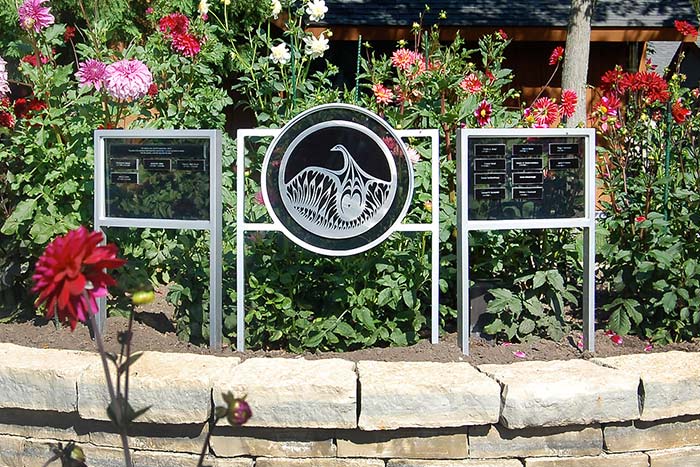
Located at the top of Dahlia Hill is a Donor's Circle with plaques listing the names of those who contributed to purchase and to terrace the land. A section also names donors who contribute to our endowment fund. Contributions to the fund may be made online at the Midland Area Community Foundation. Please specify that the donation is to go to the Dahlia Hill Society endowment fund and whether you wish the Dahlia Hill Society to be notified of your gift.
Live the paradaoxes - celebrate the equinoxes - unite equal opposites
“Life is a paradox. It is both a mystery to be lived and a problem to be solved.” In Charles Breed’s art he explores the paradox of life – the fine line between rational and irrational, facts and feelings, real and imagined. He was always fascinated by the mobius, an object that appears to have two sides but really has only one side. To illustrate another paradox - “If you wish to live, you must first attend your own funeral” (Katherine Mansfield) – he celebrated his funeral on his eighty-first birthday.
Charles art also celebrates nature. He believes that death and taxes are not the only absolutes in life. The equinoxes, solstices, sun and moon risings are cyclic constants that can enrich our daily lives – offering stability as permanent, positive absolutes. At his Traverse City cottage, he built an environment to watch the full moon rise. The themes of nature and the seasons resonate throughout his artwork. Shapes are often plant inspired. Sensual, encircling lines represent the cycles of life.
“Feelings are the realities of the imagination, facts are the realities of life. When all the facts are arranged, through feelings, into a satisfying form, the result is a composed order expression.” – Alden B. Dow
Charles first attempt to unite equal opposites occurred before he met Alden Dow. As an eighteen-year-old, Charles made a two-headed car as an art/shop project. Later, he ran for president of the United States on a platform of equality-balance-centering – proposing that senators be elected in equal numbers of men and women.
In 1960 Charles received a grant from the Dow Chemical Foundation to develop plastic as a fine art medium. For twenty-six years he used polyester to create artwork unlike any made before. With a studio at the Post Street Workshop, he developed several different methods of constructing plastic art.
In some cases, liquid polyester was poured freehand onto waxed glass or mixed with other materials and molded. Other artwork was created with polyester cast into silicone molds. Two other methods are similar to cloisonné – in one, polyester was cast in strips and bent to form a design. Colored polyester was then poured between the strips. In the other “cloisonné” method, a linear design is carved in wax and polyester was cast into the carving. After curing, pigmented polyester is poured between the ridges of the casting.
Much of Charles' artwork was not sold and can be seen at the Equiline Art studios, located at the top of Dahlia Hill.
Charles Breed bought two properties on Main Street in Midland, Michigan in 1972 and 1975. At the time, the properties contained two houses and a storage building. Bill Fisher, a local businessman who had plans to build condominiums, purchased the surrounding properties. Offers were made to buy Charles' property but he refused to sell and so the housing project fell through.
Twenty years before, Charles began to raise dahlias at his home after his wife received tubers as a Mother's Day gift from one of their daughters. By 1992 he had over 1,700 tubers and had run out of room to grow them. So, with some trepidation, he went to Bill's office and asked permission to plant dahlias on the property next to his own. Bill grew up on a farm and when he found out Charles also had a farming background (and had even milked cows) he agreed to allow Charles to plant dahlias on the vacant property at the corner of Main Street and Orchard Drive. This was the birth of what is now Dahlia Hill.
For the first five years of the garden Charles, Bill and a helper did all of the work necessary. Bill became very enthusiastic about the garden, bringing in 200 yards of topsoil and installing a watering system. Unfortunately, Charles and Bill had conflicting opinions about how to grow dahlias. By 1997, the two decided to split the garden in two - Bill and his helpers planting and maintaining one half and Charles and some volunteers the other half. These volunteers were called the Dahlia Hill Club, which evolved into the current Dahlia Hill Society.
In 1998, Charles heard that there was a possibility of plans for building on the property and asked Bill if he would consider selling. A two-year purchase agreement was signed to give Charles time to sell his cottage in Traverse City to pay for the hill. However, his daughters asked if it would be possible to find another way to raise the money. John Riecker, a prominent Midland attorney, donated two years of legal assistance to help form a non-profit organization to raise money to purchase the property. Individuals, private groups and local foundations all contributed funds.
When Charles turned 75, in 2002, he realized he would need help running the Dahlia Hill Society. David Morrison was elected as the first president of the organization, with Bernie Skowronski as vice-president, Louise Skowronski as secretary and Cinda Morrison as treasurer. Peggy Kernstock was hired as Administrative Director to do the day-to-day organization of the Society.
Heavy rain had caused problems with erosion through the years. In 2005 a plan was made to terrace the garden area. With the help of the Dahlia Hill volunteers, money was raised and construction was started in 2006. Dedication of the finished project was held in 2008 along with the installation of five sculptures made by Charles Breed.
Start your day at Dahlia Hill and be within walking distance of many cultural and historical attractions in Midland.
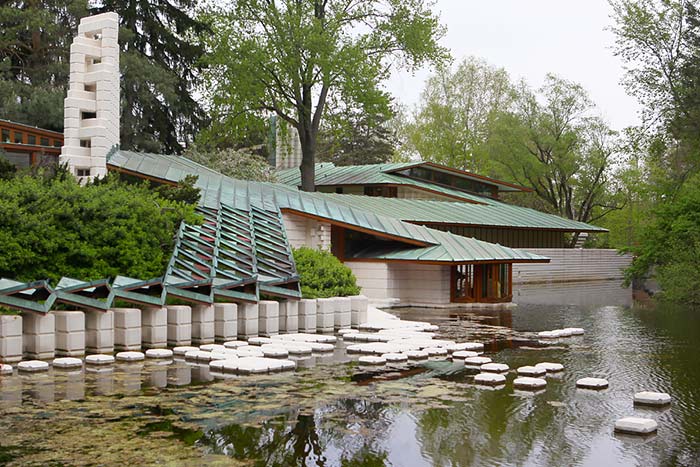
Just south of Dahlia Hill is the world famous Alden Dow Home and Studio. Follow Orchard Drive to St. Andrews, past the Molecular Institute and end up at Dow Gardens, the Midland Center for the Arts and the Grace Dow Library. Take Main Street a block north to Heritage Park and spend a while at the museums and Bradley House.
For a longer hike, follow the Pere-Marquette Rail-Trail from Dahlia Hill south, past the Historical District and the Midland Courthouse to spend an afternoon in downtown Midland. Visit the Tridge, go to the Farmer's Market and have a meal at any of a variety of downtown eateries. For more information about Midland, go to the Midland Convention and Visitors Bureau or to the City of Midland website.
Dahlias require full sun and well-drained soil, but are otherwise easy to grow. As Charles Breed often says - "They grow despite us." Some gardeners don't plant dahlias because they believe them to be high maintenance, requiring digging and storage over the winter. But, to quote Scott Kunst from Old House Gardens, "No, you don't have to dig and store them - at least it's not a law in Michigan" - or anywhere else, as far as we know. Many gardeners in colder climates now treat them as annuals, buying new plants every year.
Taller dahlias may need to be staked, but there are low growing varieties that can be used at the front of the border or in pots. Garden Gate magazine (March 2007) suggests allowing plants less than three feet tall to simply cascade over a low wall. Some varieties with small stems may be allowed to "weave" between other plants, needing only minimal support.
Named after Swedish botanist Andreas Dahl, dahlias originated in the mountains of South and Central America. The first published account of dahlias was in 1651. Sent to Europe by the director of the Botanical Garden at Mexico City, they didn't become well known until the early 1800's. Most existing cultivars came from three varieties grown in Madrid by Jose Cavanilles in 1789 - Dahlia pinnata, Dahlia coccinea and Dahlia rosea. Gardeners in Europe and Northern America soon began hybridizing them, eventually creating thousands of new forms. By 1855 the enthusiasm for new dahlia varieties was almost as great as the demand for tulips had been in the 17th century. Around this time the first "Dahlia Register" listed 3,000 varieties with at least 14 classes of dahlias.
Dahlias are members of the Asteraceae family, along with Cosmos, Bidens and Coreopsis. There are 35 species dahlias, but only a few are available to growers. Species dahlias generally have single flowers and are not as complex as the hybridized forms. Species dahlias grow true from seed, whereas hybridized dahlias grown from seed often look nothing like the parent plant. Dahlia Hill will begin growing some species dahlias in 2010.
Excellent resources about the history and classification of dahlias include the Encyclopedia of Dahlias by Bill McClaren and the American Dahlia Society.
Map to Dahlia Hill
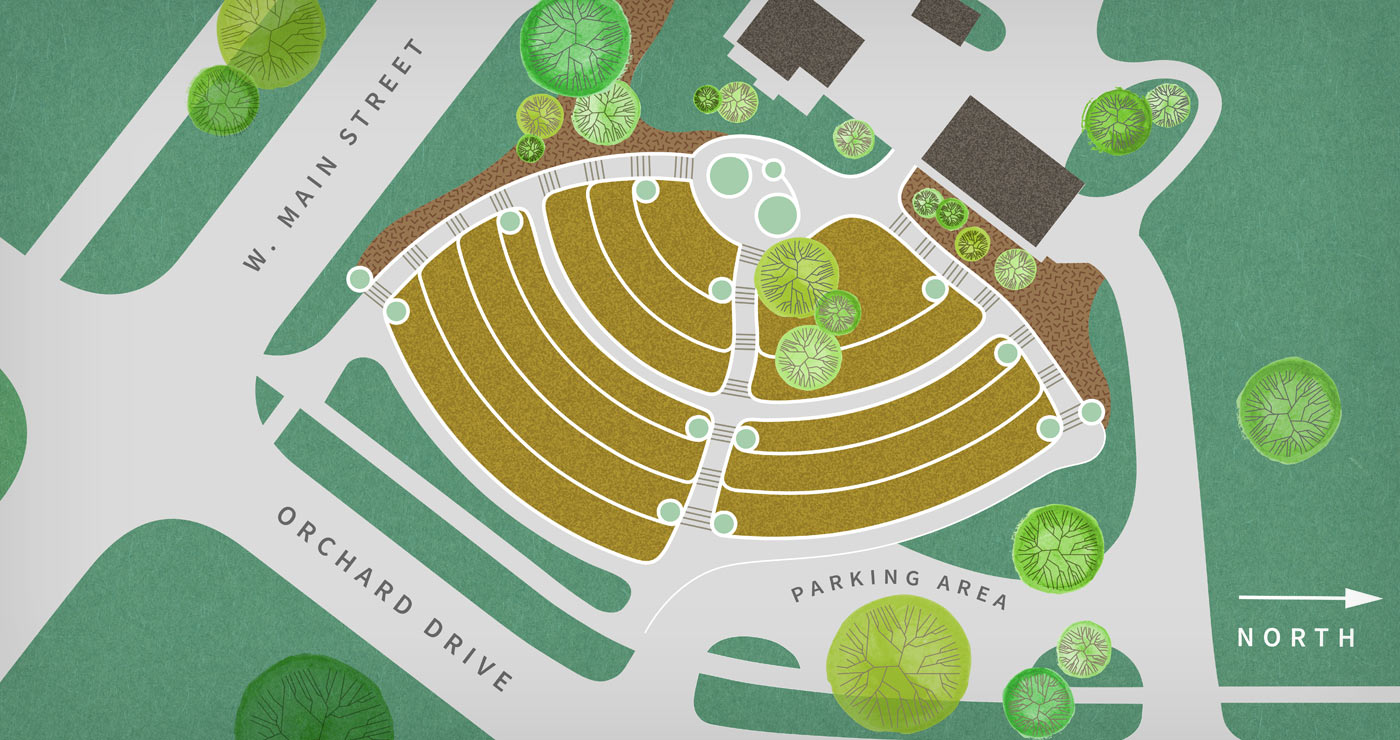
Dahlia Hill is located on Main Street, about one mile north of Downtown Midland, directly across from the entrance to Emerson Park. On a prominent intersection in Midland, Dahlia Hill is at the center of a group of cultural and historical Midland attractions. Because of these proximities, over 11,000 cars drive past the hill every day.
Dahlia Hill is a peaceful spot to stop and relax, take photos or have a picnic lunch. The garden is open from dawn to dusk every day, free of charge. The best time to view the dahlias is from late July through October. For visitors who have walking difficulties, access to the top of the Hill can be arranged by calling us.
Please be courteous while taking pictures. Contact us if you wish to photograph a group event at Dahlia Hill.
If your club or organization would like to tour Dahlia Hill, contact us to make arrangements for a guide to show you the garden and studios. Parking is available on site, accessed from Orchard Drive.
To ensure that coming to Dahlia Hill is a pleasurable experience for everyone, please be considerate while on the property.
Volunteers are what make Dahlia Hill possible. A lot of work goes into the upkeep of the Hill. It isn't all work, though. Once or twice during the summer the members get together for a potluck supper. There are bi-annual membership meetings when members get to know each other. Through the year, opportunities arise for socializing. Because of shared gardening interests, many friendships have evolved. One couple started dating after meeting as volunteers and is now married. Another couple also became engaged after meeting on the Hill.
Work at Dahlia hill begins the first week in May. Crews work in two-hour shifts to sort, count and plant the dahlia tubers. Volunteers also help at the tuber sales on the last two Saturdays of May.
Through the summer, volunteers who maintain rows set their own hours. Weekly responsibilities include weeding, staking and deadheading. A list of the week's maintenance needs is posted on the door of the workroom. There is also a work night, on the second Monday of each month, when all available members help fine-tune the Hill.
October is another busy month. After a hard frost kills the foliage, the stalks of the dahlias are cut down. Volunteers then dig the tubers, wash, divide, label and store them. Dividing can take several weeks and some interesting conversations occur over the cutting table.
Master Gardeners can earn volunteer hours by becoming a member of Dahlia Hill or by working on the Master Gardener row.
Each member of Dahlia Hill receives 10 free tubers in the spring - more if there are any left after the sale. In September, limited cutting of flowers is allowed by volunteers. If you are interested in being a volunteer, fill out an application and return it to us. If you want more information about becoming a volunteer email or call Peggy Kernstock at 989-631-0100.
Over 260 dahlia varieties are planted at Dahlia Hill. Downloadable list of varieties for 2012. Each of the 19 petal forms is represented. If you are interested in growing any of these varieties, we sell our extra tubers on the last two Saturdays in May. The sale is held in the workroom at Dahlia Hill. We're sorry, but we do not have the resources to ship tubers. Not all varieties are available for sale every year, so contact us if you are coming to the sale and are looking for a specific dahlia type. Mail order sources for many of our dahlias are available online at The Big List. Descriptions of dahlia types and colors can be found at the American Dahlia Society website.
2012 DAHLIA HILL SOCIETY BOARD OF DIRECTORS
President – Jack Telfer Vice President – Don Smith
Treasurer – Bernie Skowronski Secretary – Marilyn Zank
Historian – David Morrison Founder – Charles Breed
Director - Phyllis Ahearn Director - Jodi Dudley
Director – Deb Fugate Director - Mic Hamas
Director - Marcia Steidemann Director - Cheryl Weeks-Rosten
Administrative Director – Peggy Kernstock
Honorary Director: Ester Breed Honorary Director: Bill Fisher
2012 DAHLIA HILL SOCIETY MEMBERS
Nancy Adler Phyllis Ahearn Mary Ahren Marcia Balcirak
Karin Bartling Joanie Boulton Charles Breed Sherry Brewster
Monica Cheney-Bedtelyon Rosanne Cottone Robert Dostal Dan Draves
Marcia Draves Joan Flannery Deb Fugate Jennifer Gay
Bill Graul Pam Hall Mic Hamas Chris Hays
Jane Heiss-Armitage John Holmes Peggy Kernstock Cindy Kneibel
Jean Krause Bill Krueger Connie Lesh Diane Maxson
Brian Mills Karen Ellen Mills Dave Morrison Pat Nelson
Judy Page Mary Jo Peters Cheryl Phillips Donna Phillips
Mary Rau Rolando Ruiz Felipe Sanchez Monique Scott
Bernie Skowronski Louise Skowronski Don Smith Mark Smith
Carole Steffens Marcia Steidemann Barb Strand Kevin Strand
Ruth Swarthout Roger Szeszulski Jack Telfer Jeanne Telfer
Bernadette Van Slyck Jane Waldron Cheryl Weeks-Rosten Tonnie Wood
Marilyn Zank Ralph Zemanek Carolyn Zielinski
Clayton Griffin - Life-time Member
Cecil Erb - Life-time Member
Every year, on the last two Saturdays in May, the Dahlia Hill Society sells tubers remaining after planting the garden. The sale begins at 8 am and ends at 4 pm and is held in the Dahlia Hill workroom, located under the studio closest to the parking area. Tubers are $2.00 each or 6 for $10.00.
Photos of all of the dahlia varieties available are on the walls of the workroom and volunteers are on hand to answer questions and assist in picking out tubers. All tubers are labeled and a list of the dahlias, along with planting and growing instructions, are supplied with each purchase. If you are interested in a particular variety, please contact us after May 1st to see if it will be available for sale.
Former President of Dahlia Hill, David Morrison, took outstanding photos of dahlias in the garden in 2008 and designed note cards using the images. Sets of these note cards may be purchased at Dahlia Hill during the tuber sale and throughout the year. Two sets of eight cards, each with a different dahlia image, are available. Each set of eight cards is $12.00; individual cards may be purchased for $2.00 each. Information about Dahlia Hill is included in each set of cards.
All proceeds from the sale of tubers and cards are used to support the daily maintenance of Dahlia Hill. At this time we do not have the facilities to ship products or tubers.
Charles Breed came to Midland in 1950 after seeing and admiring Alden B. Dow's architecture. Since then he has become nationally known for his pioneering work in plastics, having been a recipient of a Research Fellowship from the Dow Foundation to explore plastic as a new art form. His work was featured in the Museum of Contemporary Crafts in New York City, the Smithsonian Institute of Washington D.C. and in other major juried and invitational exhibitions. In 1971 he was one of four Americans chosen for the first International Small Sculpture Biennial in Budapest, Hungary. Articles about him and his art have been in House Beautiful, People Magazine, Adornment Magazine, Paramount News and CBS's P.M. Magazine. His work is in private and corporate collections and commissions for municipal, religious and civic organizations in America, Japan, Canada and Denmark.
Honored as an "Outstanding Michigan Artist" by Governor George Romney in 1965, Charles also received the "Governor's Award for Excellence in Design" in 1978 from Governor William Milliken. He was awarded a "Master Grant in Plastics" by the Michigan Council for the Arts in 1982, a "Lifetime Artistic Achievement" Award from Arts Midland in 2001 and a "Distinguished Artists and Educators" Award from Western Michigan University School of Art in 2003.
Charles taught art for over 40 years on all educational levels. He taught and directed programs for Delta College, the University of Michigan, Western Michigan University and the National Music Camp, was a past president of the Michigan Art Education Association and received the Bergstein "Outstanding Teacher of the Year" Award while at Delta College. He served as a consultant and lecturer on design and was active in other local, state and national art educational and cultural organizations.
The business he started in 1958, Equiline Design Ltd., makes art pieces based on his designs. All profits from sales are donated to the Dahlia Hill Society. All of Charles' work is signed with the logo OlllO, which is a stylized adaptation of his last name.
Because Dahlia Hill is planted on a sloping site, there has always been a problem with erosion. Heavy rains washed away topsoil, fertilizer and sometimes planted tubers. Water damage caused hours of extra work every year and the quality of the garden was often compromised.
In 2003, Charles Breed and Peggy Kernstock began designing a plan to terrace the Hill. Models were built and preliminary plans were presented to the Dahlia Hill Society members. After three years of discussion, a final plan was sent to local landscape firms for bids.
Initial estimates for construction were around $220,000. The Board of Directors began the process of raising funds to do the terracing. Board member Don Smith hosted a party in early May of 2006 to initiate awareness of the project and 15,000 flyers were distributed in the Midland Daily News. The public response was overwhelming and several local philanthropic foundations contributed the balance of the money needed.
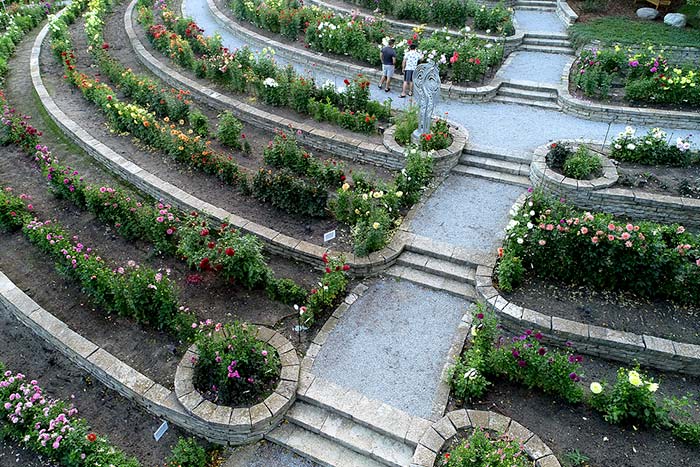
Reder Landscaping, Inc. was chosen to do the construction. Work began in November of 2006. First, the existing topsoil was stripped and stored. The terrace contours were laid out and the Hill excavated and shaped. Electrical and irrigation systems were installed and half of the retaining walls were constructed before winter set in.
In March 2007, construction continued with the completion of the retaining walls, stone slab steps and gravel paths. Topsoil was returned to the terraces. The existing gravel parking area was refurbished and new lawns were established along the roadway. Construction was completed in June. Ground covers and evergreens were planted between the garden and Main Street in July to beautify the area when the dahlias are not in bloom. The final cost of the project was $290,000.
When construction was completed in 2007, the tubers were planted in the finished terraces. Unfortunately, a combination of weather, soil compaction and depleted nutrients made for a poor growing season. In order to replenish the soil, an organic program has been implemented. In autumn of 2007 Dairy-Doo (composted cow manure) was worked into the planting beds and a cover crop of annual rye was planted. Tilling and walking on the beds has been minimized to prevent compaction. Non-chemical methods are used to control pests and organic fertilizers are utilized yearly. The dahlias grown in 2008 showed a definite improvement.
In spring of 2008, concrete bases were set in some of the circular planting beds at the ends of the retaining walls. These support sculpture pieces made and donated by Charles Breed. At the top of the Hill are plaques with the names of those who have contributed to Dahlia Hill. A Memorial Circle is also at the top of the Hill, where cremated remains can be interred. Benches located around the property were donated by Bill Fisher, the Norman Kowak Family and Reder Landscaping. Another sculpture by Charles Breed was donated by Jim Hansen in memory of his fiancee Barb Hurley, who he met as a volunteer at Dahlia Hill.
The four "Seasons of Life" are seven foot tall, cast aluminum sculptures designed by Charles Breed. They relate his belief that death and taxes are not the only absolutes in life - the equinoxes, solstices and moon phases are cyclic constants - positive absolutes provided by nature - that humans have depended on for eons.
The designs evolved from a sketch of the cross section of a flower's bud that Charles drew in a college botany class. "Spring" and "Fall" are symmetric - depicting the equinoxes, with equal lengths of night and day. The solstices are represented by "Summer" and "Winter" - they are asymmetric, showing the longest day and longest night of the year. The months are represented by the petal shapes near the top of each sculpture. In "Fall" these contain seeds; in "Winter" the seeds have dropped.
The sculptures are vaguely human-shaped. They symbolically show the predictable and unavoidable changes that occur in the human body and psyche as we age. "Spring" depicts youth - from birth to age twenty-five - the budding stage of life. The Hindu religion refers to it as the learning phase. "Summer" is full bloom - age twenty-five to fifty - the building phase. "Fall" is going to seed - age fifty to seventy-five - when we give back to society. "Winter" is the wilting stage - age seventy-five and up - when we let go.
Another sculpture has a cast bronze medallion of one of Charles' pieces. Incorporated in the design are the letters of the phrase "I love you". The design includes two interlocking rings and a heart, all symbols of love. The sculpture was donated by Jim Hansen in memory of his fiancee Barbara Hurley, who he met as a volunteer at Dahlia Hill. Inscribed on a plaque under the medallion are the words - "Remembering the sweetest lady I met on Dahlia Hill...my partner."
Several other sculptures have been designed by Charles for future installation at Dahlia Hill, including one dedicated to the memory of Alden B. Dow.
Dahlias are only perennial in horticultural zones 9 and warmer. That means that here, in mid-Michigan, the tubers need to be replanted every spring and dug up in the fall for storage through winter. There are as many methods of storing tubers as there are gardeners growing them. Some outstanding information about tuber care can be found at the American Dahlia Society and at the Colorado Dahlia Society websites.
To show what is required to maintain the 3,000 plus dahlias that are planted at Dahlia Hill, we outline what we do during one year.
Tuber storage is a big issue with many growers. Ideally, dahlias need to be kept at 40 to 50 degrees with high humidity. Dahlia Hill has a workroom with a temperature and humidity controlled storage room where around 10,000 tubers are stored yearly. The tubers are checked each month to see if any rot or drying has occurred. Our storage season extends from late October to April.
In the last week of April the tubers are taken out of storage. Each tuber is checked and separated into bags of those with and without buds. Using a list of the available tubers, the Administrative Director and President design the layout of the Hill for the coming year. This is more complicated than it sounds. A balance has to be struck between planting enough of each variety and making sure the Hill will look its best.
After the plan is drawn up, the tubers are placed in plastic grocery bags marked with the row where they will be planted. Planting is undertaken only after the soil temperature reaches 50 degrees, usually the second or third week of May. First, 6" deep trenches are dug with a blade on a tiller. The rows are spaced five feet apart in the center of each terrace. Bonemeal and organic compost is mixed into the soil at the bottom of each trench. The tubers are planted according to the plan, one foot apart. One to two inches of dirt is gently raked over the tubers.
Through June and July, volunteers remove weeds and pull more dirt over the tubers as the shoots grow. Cutworms, leafhoppers, wireworms, japanese beetles and spider mites are the main pests dealt with during these months. Only organic controls and fertilizers have been used at Dahlia Hill since 2005. Quick-release water connections on each terrace enable us to control spider mites by blasting them with a high-powered spray of water using a watering wand attachment. In dry, hot weather this needs to be done twice a week or more. Insecticidal soap misted on the leaves weekly keeps the leafhoppers to a minimum. Japanese beetles and cutworms are hunted daily and dropped into soapy water. We are experimenting with several organic cutworm controls - fortunately, the plants usually recover from cutworm attack. A control for wireworms hasn't been determined, other than to destroy them when found. Encouraging healthy soil and thereby, healthy plants is our main strategy for controlling pests.
The dahlias start to bloom in mid-July. Taller plants are staked using green jute twine and five foot pieces of 1/2" rebar painted dark green. Deadheading is done weekly. Soil is packed around the base of the stems to help support the plants. The programmable drip irrigation system waters deeply twice a week during dry weather.
Hard frosts have occurred as early as September 25th and as late as October 22nd. After frost kills the foliage we wait one to two weeks, allowing the tubers to harden. All stakes and twine are removed, then a hedge trimmer, pruning loppers or pruning saw are used to cut the stalks to about 6" above the soil line. The stalks are placed between the rows and chopped coarsely with a sharp shovel blade.
Care has to be taken when digging the dahlia clumps. Some varieties have long, slender tubers that break easily under the weight of the soil. As much of the dirt as possible is shoveled off the clump first. Then two people, one on each side, use shovels or forks to dig up the clump. The digging tools have to be placed at least a foot away from the stalk to avoid cutting through the tubers. Clumps are never shaken or knocked on the ground as this can break the tubers. A hose is used to thoroughly wash off the clump, which is placed with others of the same variety into a plastic garbage bag. The bags are marked with the variety and put into the workroom.
Tubers are divided in the fall - storing them undivided would require too much room. Dividing all of our tubers can take three to four weeks. Each tuber variety is taken out of its bag and the clumps divided into separate tubers, each with some of the stem attached. This is where the "eyes", or future stems, will develop. The tubers are counted and marked with an indelible pen or pencil and soaked for a few minutes in a 1:50 solution of bleach and water. While still damp, the tubers are placed in grocery bags and completely covered with vermiculite. The full bags are put into cardboard boxes and put on shelves in the storage room.
"One of the driving forces in my life has been architecture and creating environments for contemplation and celebration of the seasons and full moons as positive absolutes." — Charles Breed
Charles Breed saw the potential for creating environmental art after receiving a catalog from Swan Island Dahlias. On the back cover of the catalog was an aerial view of 40 acres of dahlias. It looked like an abstract tapestry made of flowers. He realized that he could use dahlias to paint a constantly changing artwork on the hillside garden next to his studio. His love of dahlias began in 1966 - "I think the dahlia is one of the most creative flowers because it transforms itself into so many different colors, shapes and sizes." Dahlia Hill is dedicated to the creativity of the dahlia and to Alden Dow, who inspired Charles to do something important on the site.
Initially spurred by an incident with Alden Dow, who commented that the property on Main Street was "at the eye of the cultural crescent" of Midland, Charles wanted to do something for the people of the city as a tribute to Alden. Always an environmentalist, Charles had resisted offers to sell the land for residential development. His studios and the garden exhibit his belief that there can be a balance between nature and the man-made world. Striving for this balance - between equal opposites, yin and yang, thoughts and feelings - was a theme he shared with Alden Dow and which is evident throughout both Charles' artwork and Alden's architecture.
Dahlia Hill is a celebration of the seasons, of nature and of art. The four "Seasons of Life" sculptures symbolically equate the progression of each person's life to the natural cycles of the equinoxes and solstices. The human-sized artwork reminds us of our place in nature. The garden itself is a piece of artwork, balancing the strength and endurance of stone with the fragility and transience of flowers. It is a tribute to the dahlia, to Alden Dow and to Charles Breed.
The following are proposed 2012 event dates:
Spring Membership Meeting - Thursday, April 19, 7:00 pm - At Smith's Flowers
Tuber Sale - Saturday, May 19 & May 26, 8:00 am to 4:00 pm
Clean up days - Second Wednesdays - June 13, July 11, August 10, September 14
Autumn Equinox Celebration/20th Anniversary - Sunday, September 16, 2 to 4 pm
For a $100.00 donation to Dahlia Hill, individuals, businesses or organizations can sponsor a row for the current season. Sponsorships may be made in honor of, or in memory of, friends and loved ones. They can also be designated to celebrate special events and occasions.
If you wish to sponsor a row at Dahlia Hill, please fill out a form and send it with donation to:
Dahlia Hill Society
2809 Orchard Drive
Midland, Michigan 48640
"A new life arose from the ashes"
One of the circular planters at the top of Dahlia Hill has been designated as a Memorial Circle. In this area, some of an individual's cremated remains are integrated into the soil, to continue the cycle of life - nourishing and thereby becoming a dahlia. Names and life dates of those who are interred are placed on the Memorial Circle plaque. Life histories may also be entered in a Book of Memory, located inside the museum. Arrangements for a memorial service at the time of interment are left to the discretion of family and friends.
A three hundred dollar donation is requested of anyone wishing to place ashes in the Memorial Circle. If you wish to make arrangements to place your own or a loved one's ashes at Dahlia Hill, please call 989.631.0100.
When you visit the Dahlia Hill garden, walk up any of three stairways to be surrounded by 3,000 dahlia plants arranged on eight stone terraces. You will see over 250 varieties of dahlias, with an example of each variety planted and labeled along gravel pathways. At intervals along the stairways you can stop to examine four cast aluminum sculptures by local artist Charles Breed, depicting the cycles of life and the seasons. Benches and resting areas are located near the parking area and at the top terrace. Also at the top of the Hill are two raised planters - one a donor circle and the other a memorial circle.
The Dahlia Hill Society is a not-for-profit organization with the purpose of educating the public about dahlias. Unlike many other societies, whose members grow dahlias for shows or competitions, our goal is to have show-quality dahlias in a garden setting. If you see a volunteer working in the garden when you visit, feel free to ask questions.
Dahlias are unlike any other flower. Blossom sizes range from 2" pompons to 14" dinner plates and they come in every color except blue. Plant heights also vary, from 1 1/2 foot dwarfs to 6 foot giants. The American Dahlia Society describes 19 different petal forms including daisy-like singles, spidery cactus, classic balls and exuberant informal decoratives. Examples of each flower form can be seen on Dahlia Hill.
Dahlias are finally receiving the recognition they so richly deserve. Several gardening magazines have recently featured the unique qualities of dahlias. Martha Stewart Living (March 2006), Fine Gardening (June 2008), Garden Design (July 2005) and Midwest Living (September 2006) all featured dahlias, describing them as "sassy but elegant", "a late-season gardeners best friend" and the "quintessential cut flower".
Christopher Lloyd, the great English plantsman, used dahlias on the covers of three of his later books. Defining them as exotic, he prefers to "assimilate dahlias into the garden's fabric" by carefully choosing varieties, sizes and colors that coordinate with the other plants in the garden. In his words - "Dahlias spell excitement and we can do with some of that in our lives."
Dahlias are amazing plants and should be considered by every gardener as a way to enliven late summer plantings.
Dahlia Hill would not exist without its volunteer members. Every year, over 50 people spend hundreds of hours maintaining the garden. In the spring, a month is spent sorting, planting and selling the tubers. Throughout the summer, weeding, staking and deadheading are done weekly. The first frost in autumn brings several more weeks of digging, dividing, labeling and storing the tubers for winter.
A volunteer Board of Directors governs the Dahlia Hill Society. In addition to the above duties, members of the Board help to design the yearly planting plan for the garden, head various committees and lead two annual membership meetings.
Dahlia Hill is recognized as a volunteer project by the Midland County Master Gardeners. Master Gardeners can either become members of the society or work with a member. Membership in the Dahlia Hill Society includes free tubers every spring and limited cutting of flowers in the fall. New members are always welcome. The only membership fee is the time worked in the garden. If interested, please fill out an application form or call us for more information.
1966 Crisann Breed gave her mother yellow and red dahlia tubers for Mother's Day. Her father, Charles Breed, planted the tubers and began a life-long love affair with dahlias.
1992 Bill Fisher owned hillside property on Main Street, next to Charles Breed's design studio. The property was an ideal site for development, but had been vacant for several years. Charles requested permission to plant dahlias on the property and Bill agreed. With 1,700 tubers from Charles and 200 yards of topsoil contributed by Bill, they began Dahlia Hill.
1997 Charles built a new studio and gallery with a workroom for meetings and tuber storage. Bill enlarged the garden area and installed a sprinkler system.
1998-2000 The Dahlia Hill Society of Midland was founded as a not-for-profit organization. The society raised money from foundations and private donors to purchase the hill property for $175,000 from the Fisher Contracting Company.
2002 The first Board of Directors was elected and an Administrative Director was hired.
2006-2007 Because of continuing problems with erosion, money was raised from individuals and area foundations and Dahlia Hill was terraced.
2008 The terracing project was dedicated and four cast aluminum sculptures were made by Charles Breed and donated to Dahlia Hill.
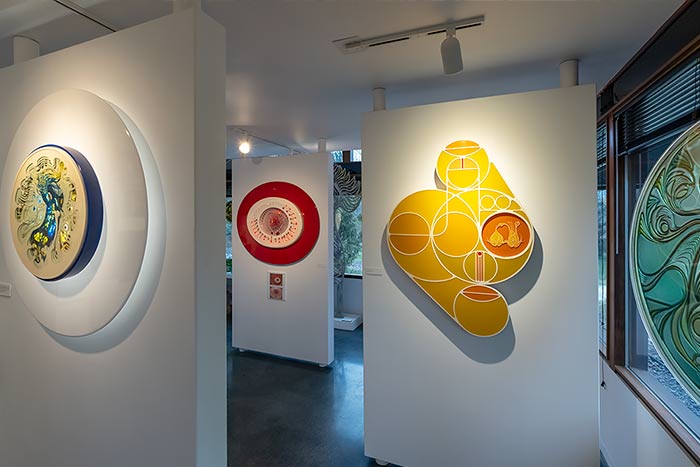
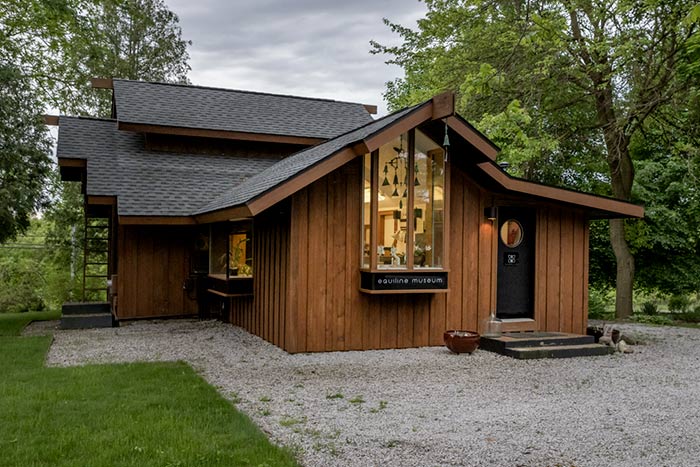
At the top of Dahlia Hill is a studio and museum with exhibits of original designs by Charles Breed, known nationally for his innovative work using plastic as an art medium. His business, Equiline Design Ltd., produces artwork which is sold online. Reproductions of the sculptures on Dahlia Hill can be purchased through Equiline Design Ltd. Other art pieces available for purchase include "Memory Vessels", used to store cremated remains, and a variety of sculptures in cast paper, bronze and plastic based on Charles Breed's designs. All profits from Equiline Design Ltd. are donated to Dahlia Hill, to support maintenance and operating costs.
Someone is generally in the studio Monday through Saturday, from 9 a.m. to noon and from 1 to 5 p.m. If you would like to tour the studio and museum when you are at Dahlia Hill, please contact us to make arrangements.
The Dahlia Hill Society of Midland is a 501(c)(3), not-for-profit organization. The garden is open to the public free of charge. There are many ways you may help Dahlia Hill pay for operating expenses.
DONATE - Tax-deductible donations may be made directly to the Dahlia Hill Society. Donations may also be made to the Society's endowment fund at the Midland Area Foundation.
PURCHASE - Extra dahlia tubers are sold each spring on the last two Saturdays in May. Dahlia notecards are available to purchase at any time of the year.
SPONSOR ROW - You or your business may sponsor a row on Dahlia Hill for one season. Donations may be made in honor of, or in memory of a friend or family member.
MEMORIAL CIRCLE - Reserve a place in the Memorial Circle, where cremated remains are integrated into the soil to then come up as dahlias.
EQUILINE DESIGN LTD. - all profits from the sale of artwork are donated to the operating fund of Dahlia Hill.
Coming soon.
Eight terraces planted yearly with 3,000 dahlias - over 250 varieties
A free dahlia garden maintained entirely by volunteers
On a prominent corner centered among the cultural attractions of Midland
A Memorial Circle for cremated remains to be resurrected as dahlias
Garden sculpture on view year round
Artist Charles Breed's working studio and museum
Watch a video about Dahlia Hill and its founder, Charles Breed.
If you are looking for:
Equiline Design Ltd. Artwork for garden and home, profits donated to Dahlia Hill